Have you ever looked at a measurement on a ruler and thought, “Well, that sounds tiny, but what does it actually look like?” It’s a funny little problem we all run into. Numbers can feel a bit cold and distant untill they connect to something real. That’s especially true when we’re talking about millimeters.
When someone asks, “How Big Is 2mm?”, the answer seems simple. It’s two millimeters. Yet somehow that explanation doesn’t help much, does it? Our brains like comparisons. We understand size better when we can hold it, see it, or compare it with something sitting right there on the kitchen table.
The 2mm size is surprisingly common in everyday life. From food ingredients and insects to technology and construction materials, you’ll find examples of this tiny measurement almost everywhere. While 2 millimeters may sound incredibly small, it remains visible to the human eye and often plays an important role in design, engineering, manufacturing, and even nature.
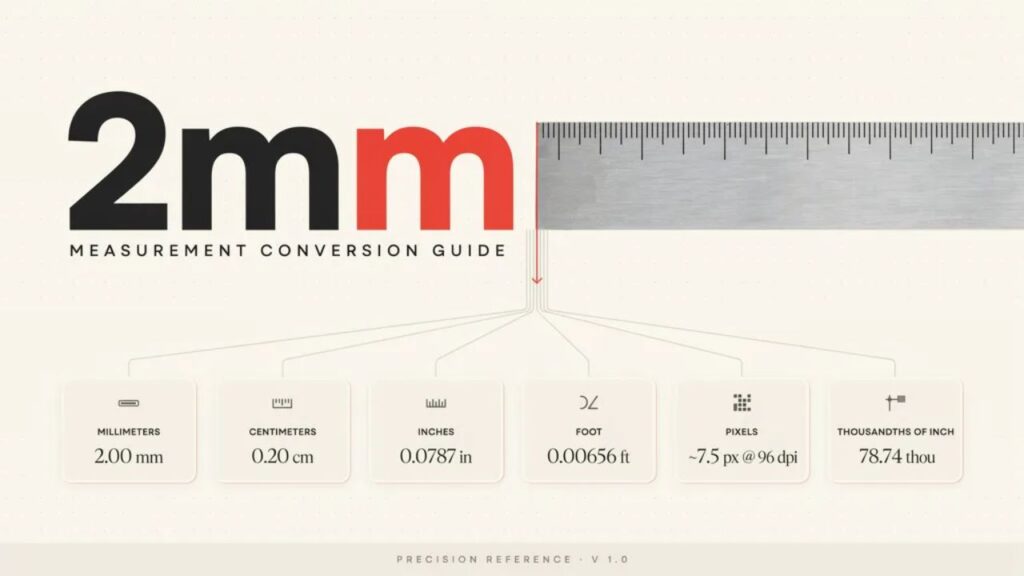
To put it into perspective, 2mm measurement equals:
- 0.2 centimeters
- 0.0787 inches (often rounded to 0.08 inches)
- 2000 micrometers
- 0.002 meters
- 0.00656 feet
- 0.00219 yards
- 0.000002 kilometers
But numbers alone rarely paint the full picture. Let’s explore some familiar objects that help answer the question: what does 2mm look like in real life?
| Object | Approximate Size | Why It’s a Good 2mm Reference |
|---|---|---|
| Pencil Lead | 2mm diameter | Common mechanical pencil lead thickness |
| Mustard Seed | 1–2mm | Tiny seed often used in cooking |
| Small Ant | About 2mm long | Easy natural size comparison |
| Ceramic Tile Spacer | 2mm thick | Used to create even tile gaps |
| Nickel Coin | 1.95mm thick | Very close to 2mm thickness |
| Smartphone Screen Glass | Around 2mm | Similar thickness in some screen assemblies |
| Watch Screw | About 2mm diameter | Common precision engineering component |
| Rice Grain Width | Around 2mm wide | Helpful everyday food reference |
| Matchstick Thickness | About 2mm | Simple household size comparison |
How Big Is 2mm Compared to Everyday Objects?
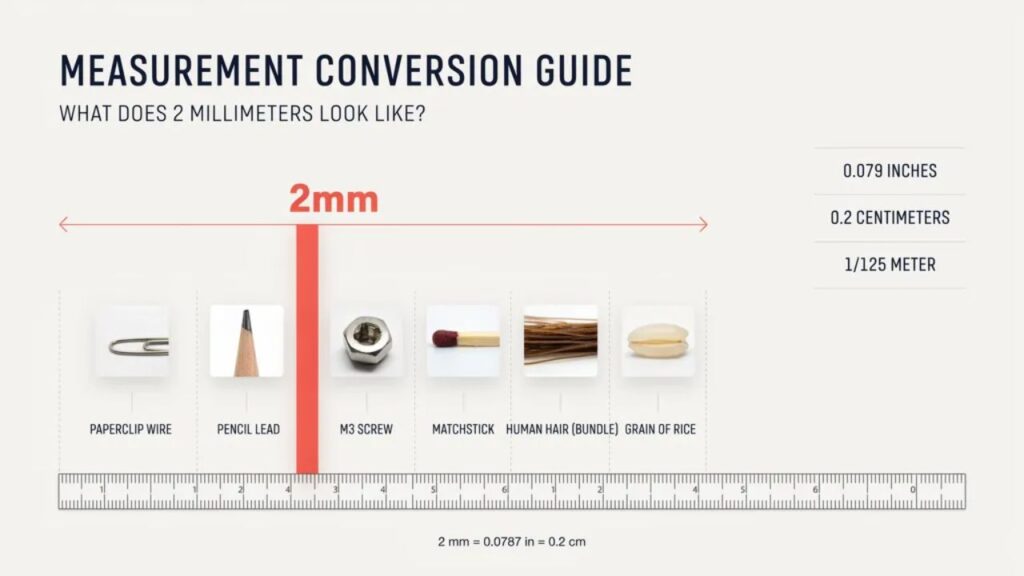
One of the easiest ways to understand how big is 2 mm is to compare it with ordinary objects you encounter every day. The world is full of tiny dimensions that quietly go unnoticed.
Imagine the thickness of a small seed, the width of a tiny screw, or the body size of a miniature ant. Suddenly, 2 millimeters starts feeling much less abstract. It’s small, sure, but not invisible. It’s the kind of size you notice only after someone points it out, then you start seeing it everywhere. Kinda strange how that works.
Below are nine common examples that can help you visualize things that are 2mm in size.
Pencil Lead
Perhaps the most recognizable example is certain types of mechanical pencil lead.
Many mechanical pencils use lead measuring approximately 2mm in diameter. Traditional drafting pencils and artist pencils often feature this thicker lead because it creates darker marks and resists breaking more effectively.
The lead itself is made from graphite, mixed with clay and other materials. Holding a piece of 2mm pencil lead between your fingers is one of the clearest ways to understand a 2mm size comparison.
Interestingly, artists often prefer thicker lead because it feels more expressive. It’s funny really, such a tiny measurement can completely change how a drawing feels.
Mustard Seed
A mustard seed offers one of nature’s simplest examples of a tiny measurement.
The seeds of Brassica nigra, commonly used in cooking and agriculture, often measure around 1 to 2 millimeters in diameter. This makes them excellent references when wondering about objects that are 2mm.
Beyond cooking, mustard seeds have symbolic significance in many cultures and religious teachings. Something so small can represent growth, faith, and possibility. Not bad for a little round seed that’s barely larger than a speck.
A Small Ant
Nature provides another excellent visual guide.
Certain species of ants measure roughly 2 millimeters in body length. When you spot one hurrying across a sidewalk, you’re often looking at a living example of a 2mm object size reference.
Ant colonies showcase incredible examples of nature’s engineering. Despite their tiny dimensions, ants build complex societies, create tunnels, organize food systems, and communicate efficiently.
It’s almost unfair honestly. At only 2mm long, some ants seem more organized than entire office departments.
Ceramic Tile Spacer
If you’ve ever completed a home renovation project, you’ve probably encountered ceramic tile spacers.
These small plastic pieces help maintain consistent gaps between tiles during installation. Many standard spacers measure exactly 2 millimeters.
In flooring, home renovation, and ceramic tile installation, maintaining accurate spacing is essential for both appearance and durability. The humble tile spacer demonstrates how important a precise measurement can be.
A tiny error repeated hundreds of times can become a huge problem. That’s why professionals obsess over details most people never even notice.
Nickel Coin Thickness
Coins provide another handy comparison.
A U.S. nickel has a thickness of approximately 1.95mm, making it extremely close to the 2mm thickness we’re discussing.
Most people have handled thousands of coins throughout their lives without ever considering their dimensions. Yet the thickness of a nickel serves as a remarkably practical reference point.
The next time someone asks, “How thick is 2mm?” you can simply imagine the edge of a nickel coin.
How Big Is 2mm in Technology?
Modern technology depends heavily on tiny measurements. In fact, many electronic devices wouldn’t function properly without extraordinary manufacturing precision.
The world inside your smartphone is packed with components measured in fractions of millimeters. What feels insignificant to us often represents critical engineering decisions.
Let’s look at a few examples.
Smartphone Screen Glass
The glass protecting many smartphones often falls near the 2mm range when considering protective layers and overall screen assemblies.
Modern smartphone display systems rely on advanced tempered glass technology. Manufacturers carefully balance durability, touch sensitivity, visibility, and weight.
A difference of just a millimeter or two can significantly affect device durability. That’s pretty wild if you think about it. Something thinner than a coin edge helps protect thousands of dollars worth of technology every day.
Tiny Watch Screws
Watchmakers operate in a world where fractions of millimeters matter constantly.
Many watch screws measure approximately 2mm in diameter. These miniature components hold intricate mechanisms together while maintaining precision and reliability.
The field of watchmaking remains one of the best demonstrations of mechanical precision and micro-engineering. Looking at these screws often makes people realize just how small 2 millimeters actually is.
And somehow, humans decided it was a good idea to manufacture thousands of these tiny parts. Remarkable and slightly crazy.
How Big Is 2mm in Food and Nature?
Nature and food offer some of the easiest visual references because they’re familiar to almost everyone.
Measurements become easier to understand when connected to things we eat, grow, or encounter outdoors.
Rice Grain Width
While rice grains vary considerably, the width of many varieties falls near the 2mm range.
Both Basmati rice and Jasmine rice can provide useful references when discussing things that measure 2 millimeters.
The length of rice grains differs significantly, but their width often aligns closely with our target measurement.
Next time you’re cooking dinner, grab a grain and take a closer look. It’s amazing how much detail exists in everyday ingredients we barely notice.
Matchstick Thickness
A standard wooden matchstick is often close to 2mm thick in certain sections.
The combination of wood, chemical compounds, and manufacturing precision creates a simple but effective size reference.
For decades, matchsticks have remained largely unchanged because their dimensions strike a practical balance between durability and functionality.
Sometimes old designs stick around because they’re already pretty much perfect.
Common Objects That Help Visualize 2mm
One challenge people face is understanding whether 2mm is very small.
The answer depends entirely on context.
For a building? Tiny.
For a smartphone component? Significant.
For an insect? Fairly large.
For a human hair? Quite thick.
This relativity explains why visual references matter so much. When asking what does 2mm look like, comparisons provide more clarity than measurements alone.
Additional examples include:
- Certain eyeglass frame screws
- Thin plastic spacers
- Small electronic components
- Some decorative beads
- Precision washers
- Thin cable coatings
- Certain crafting materials
The more examples you encounter, the easier it becomes to estimate dimensions accurately in daily life.
Why 2mm Matters in Engineering and Manufacturing
At first glance, 2 millimeters may seem trivial.
In reality, industries around the world depend on dimensions this small. Engineering precision often determines whether products succeed or fail.
Manufacturers work with incredibly tight tolerances because even tiny deviations can affect:
- Structural integrity
- Product durability
- Device performance
- Mechanical reliability
- User safety
- Manufacturing accuracy
- Functional design
From medical equipment to automotive components, component thickness frequently falls within ranges measured in mere millimeters.
It’s a reminder that small details aren’t really small at all. They’re just concentrated importance, if that makes sense.
2mm Measurement Conversion Guide
Understanding conversions can make visualization easier.
Here’s a quick reference:
| Measurement Unit | Equivalent to 2mm |
|---|---|
| Millimeters | 2mm |
| Centimeters | 0.2 cm |
| Inches | 0.0787 inches |
| Micrometers | 2000 µm |
| Meters | 0.002 m |
| Feet | 0.00656 ft |
| Yards | 0.00219 yd |
| Kilometers | 0.000002 km |
These conversions help answer questions like 2mm in inches, 2mm in centimeters, and 2000 micrometers.
For most people though, visual comparisons remain easier than memorizing numbers.
Is 2mm Visible to the Human Eye?
Absolutely.
One common misconception is that 2 millimeters is too small to see. That’s not true at all.
The average human eye can easily detect objects measuring 2mm under normal lighting conditions. In fact, many of the examples discussed throughout this guide are visible from several feet away.
What becomes difficult is accurately estimating that measurement without a reference point.
That’s why using everyday objects, seeds, insects, screws, or coins works so well for developing size awareness.
After awhile, your brain starts building a mental library of dimensions. It’s oddly satisfying once that happens.
FAQs About 2mm Size
What does 2mm look like?
A 2mm measurement is roughly the thickness of a nickel coin or the diameter of a piece of 2mm pencil lead. It is small but easily visible to the naked eye.
Is 2mm very small?
Yes, 2mm is considered a very small measurement. However, it is still large enough to be seen clearly without magnification in normal lighting conditions.
What is 2mm in inches?
2mm equals approximately 0.0787 inches, which is commonly rounded to 0.08 inches.
What are some common things that are 2mm in size?
Examples include mustard seeds, small ants, 2mm pencil lead, ceramic tile spacers, watch screws, and the thickness of a nickel coin.
How can I visualize 2mm easily?
The easiest way is to compare it to everyday objects such as a mustard seed, a matchstick’s thickness, or the edge thickness of a nickel coin.
Read This Blog;https://meaninges.com/pringles-dimensions/
Final Thoughts on How Big Is 2mm
So, How Big Is 2mm really?
It’s tiny, but not microscopic. It’s small enough to be overlooked yet large enough to play a critical role in technology, construction, food production, nature, and manufacturing.
Whether you’re comparing it to a mustard seed, a small ant, a piece of pencil lead, a ceramic tile spacer, a nickel coin, a rice grain, a watch screw, a matchstick, or smartphone screen glass, each example offers a practical way to understand this measurement.
The next time someone asks how big is 2mm compared to everyday objects, you’ll have plenty of answers. More importantly, you’ll have real-world references that transform an abstract number into something tangible.
Sometimes the smallest measurements tell the biggest stories. A little seed, a tiny screw, a sliver of glass, they all remind us that size alone doesn’t determine significance. And honestly, that’s a rather nice thing to remember.