There is something oddly comforting about measuring things correctly. Maybe it reminds us that even in a world where mornings run late and recipes get splattered with sauce, a little precision still has a place. I still remember watching my grandmother pour what she called “about a cup” of milk into a bowl. Then she’d smile when someone asked for the exact amount and quietly say, “Well depends who’s eating.” Funny enough, when I later tried baking on my own, I learned that those tiny differences actually mattered quite alot.
That’s where a Milliliters to Grams Conversion Calculator becomes surprisingly useful. It isn’t just another online gadget sitting around doing math. It’s a practical bridge between Volume and Mass, helping cooks, bakers, students, scientists, and even hobbyists make accurate measurements without second-guessing themselves. Whether you’re adjusting a treasured family recipe, mixing laboratory solutions, or simply wondering how 100 ml to grams works, understanding the relationship between Milliliter, Gram, and Density can save time, ingredients, and maybe even your mood.
This guide explores everything you should know about Milliliters to Grams Conversion, why density changes everything, how calculators work, and why accuracy matters far more than many people realise.
| Ingredient | Density (g/mL) | 100 mL to Grams |
|---|---|---|
| Water | 1.00 | 100 g |
| Milk | 1.03 | 103 g |
| Cooking Oil | 0.92 | 92 g |
| Honey | 1.42 | 142 g |
| All-Purpose Flour | 0.53 | 53 g |
| Granulated Sugar | 0.85 | 85 g |
| Powdered Sugar | 0.50 | 50 g |
Formula: Grams = Milliliters × Density (g/mL)
What Is Milliliters to Grams Conversion?
At first glance, converting milliliters into grams seems like basic arithmetic. It kinda feels like converting inches into centimeters. But there’s a catch volume and weight aren’t measuring the same physical property.
A Milliliter measures Volume, while a Gram measures Mass. Because these represent different Physical Quantities, you need one extra piece of information before making the conversion.
That missing link is Density.
Without density, asking “How many grams are in 100 ml?” is like asking how many people fit into a room without saying how big the people are. Weird comparison? Maybe. But it works.
The universally accepted equation is:
grams = milliliters × density
This simple relationship powers every reliable mL to grams calculator available today.
Why Density Changes Everything in Milliliters to Grams Conversion
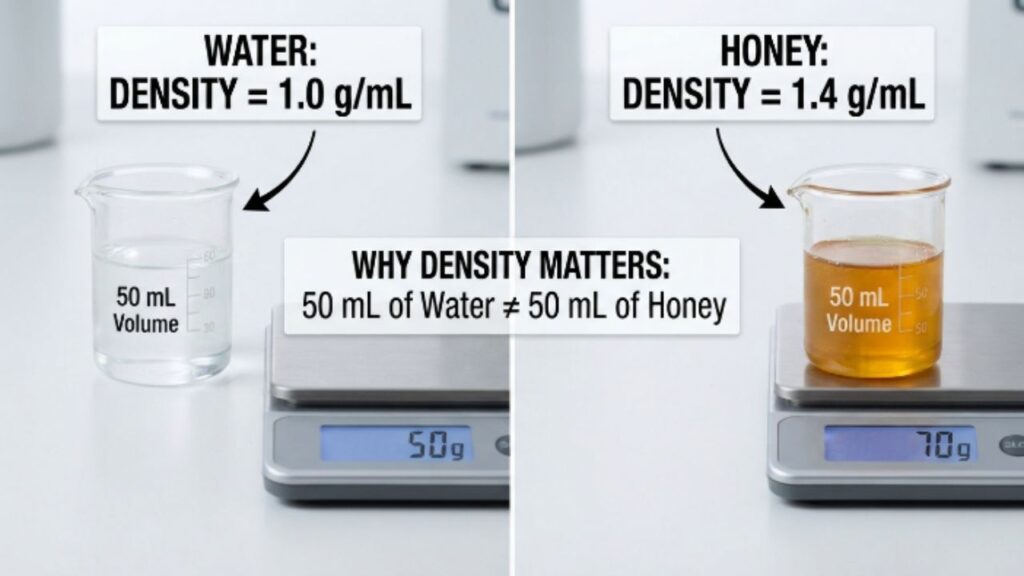
Here’s where the whole thing gets interesting.
Imagine filling two identical measuring cups.
One contains water.
The other contains honey.
They occupy exactly the same space, yet one feels dramatically heavier in your hand. That difference comes from Density.
Every substance has its own density, which tells us how much mass fits into a certain amount of volume.
Examples include:
- Water: approximately 1 g/mL
- Milk: around 1.03 g/mL
- Cooking Oil: around 0.92 g/mL
- Honey: approximately 1.42 g/mL
- All-Purpose Flour: varies depending on packing
- Granulated Sugar: denser than flour
- Powdered Sugar: lighter because of trapped air
So, 100 mL of water weighs roughly 100 grams.
But 100 mL of honey weighs approximately 142 grams.
And 100 mL of cooking oil weighs closer to 92 grams.
Same volume.
Different weight.
That’s why volume to weight conversion always depends on density.
How a Milliliters to Grams Conversion Calculator Works
A quality Conversion Calculator performs three basic tasks.
First, it identifies the substance you’re measuring.
Next, it retrieves the appropriate density value.
Finally, it applies the equation:
grams = milliliters × density
The calculation itself is quick enough that it almost feels invisible, which honestly is the whole point. Nobody wants to spend five minutes hunting through density tables while dough is waiting in the mixing bowl.
Modern calculators often include popular kitchen ingredients, laboratory liquids, and industrial materials, making Metric Conversion much easier than manual calculations.
Milliliters to Grams Conversion for Common Ingredients
Different ingredients produce very different answers.
Here’s an approximate reference table.
| Ingredient | 100 mL in Grams |
|---|---|
| Water | 100 g |
| Milk | 103 g |
| Cooking Oil | 92 g |
| Honey | 142 g |
| Granulated Sugar | About 85 g |
| All-Purpose Flour | About 53 g |
| Powdered Sugar | About 50 g |
Notice something?
Every answer changes because every ingredient has its own Ingredient Density.
That’s why searches like water ml to grams, milk ml to grams, oil ml to grams, flour ml to grams, sugar ml to grams, and honey ml to grams all produce different results.
Why Bakers Care So Much About Weight
Anyone who’s baked bread more than once has probably discovered this the hard way.
Scooping flour directly from the bag packs it tightly.
Spooning flour into the measuring cup leaves more air.
Suddenly one “cup” differs by twenty or thirty grams. Thats enough to change the texture of cakes, cookies, and breads.
Professional bakers usually rely on Baking Precision rather than guesswork.
Using grams instead of volume helps achieve:
- More consistent bread
- Better cake texture
- Accurate cookie spread
- Reliable pastry results
- Repeatable recipes
- Improved Recipe Conversion
- Better accurate baking measurements
A Digital Kitchen Scale often becomes the most-used tool in serious kitchens for exactly this reason.
Understanding the Metric System
The Metric System remains the international standard because it’s wonderfully logical.
Unlike older measurement systems, units increase by powers of ten.
Key relationships include:
- 1 liter = 1000 milliliters
- 1000 grams = 1 kilogram
These belong to the family of SI Units, the globally recognized measurement framework used in science, medicine, engineering, and much of everyday life.
Organizations such as the National Institute of Standards and Technology continue promoting standardized measurements to improve scientific consistency and commercial accuracy.
Because of this universal approach, SI unit conversion becomes far easier than juggling unrelated measurements.
Why Scientists Convert Milliliters to Grams
Cooking isn’t the only place where these calculations matter.
In chemistry, biology, and pharmacy, measurement accuracy can literally determine experimental success.
Laboratories routinely perform Mass-Volume Stoichiometry, where precise amounts of substances are needed for Chemical Reactions.
Researchers working with:
- Aqueous Chemicals
- Powdered Chemicals
- Solutions
- Suspensions
must often convert between volume and mass depending on experimental protocols.
Small measurement errors can influence chemical concentrations, reaction yields, and analytical results.
That’s why Laboratory Measurements place enormous emphasis on chemical measurement accuracy.
Educational organizations like the CK-12 Foundation frequently explain these measurement relationships to help students understand scientific calculations from the ground up.
Why Temperature Can Change Results
Here’s something many calculators quietly assume.
Density isn’t always fixed.
Temperature changes density.
Water becomes slightly less dense as it warms.
Cooking oils expand.
Certain chemicals behave differently under varying laboratory conditions.
For most kitchen recipes, these changes are tiny and can safely be ignored.
But in advanced scientific work involving scientific measurement, even small density changes matter.
This is one reason professional laboratories document temperature alongside measurement values.
Common Mistakes People Make
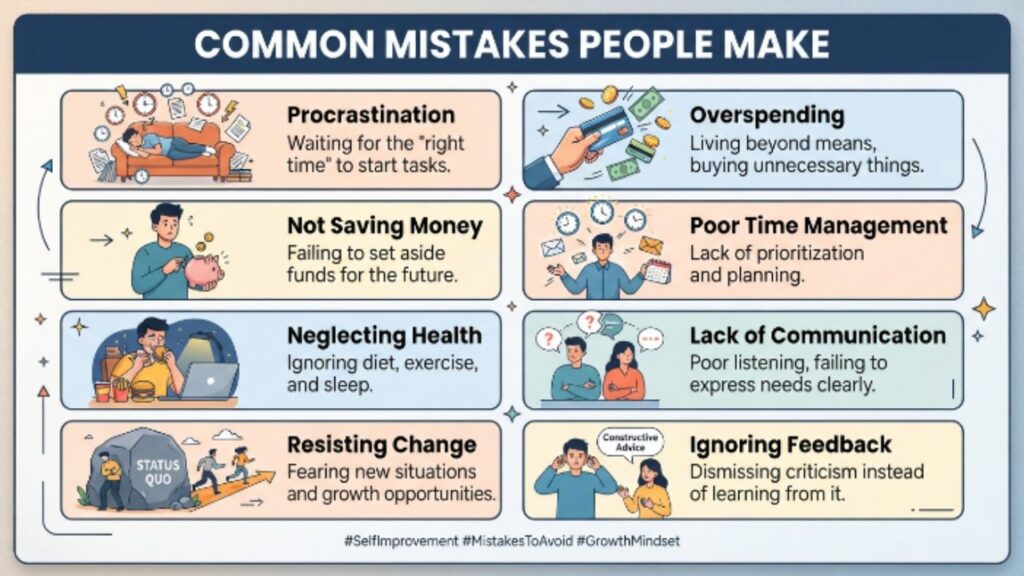
Converting between volume and weight seems easy until these little mistakes creep in.
Some common errors include:
- Assuming every liquid weighs the same as water.
- Forgetting that flour compresses differently.
- Ignoring ingredient-specific density.
- Measuring sticky ingredients inconsistently.
- Using outdated conversion charts.
- Confusing Weight Measurement with Volume.
- Mixing imperial and metric units.
Most of these disappear once people understand that ingredient density is the deciding factor.
Manual Calculation Example
Let’s walk through a practical example.
Suppose you need 250 mL of honey.
Honey density:
1.42 g/mL
Calculation:
250 × 1.42 = 355 grams
Now compare that with water.
250 × 1.00 = 250 grams
Same measuring jug.
Completely different weight.
That’s exactly why density conversion formula matters.
Digital Kitchen Scales Make Everything Easier
A good Digital Kitchen Scale removes much of the uncertainty from cooking.
Instead of filling measuring cups repeatedly, simply place the bowl on the scale, zero it, and pour until the desired weight appears.
Benefits include:
- Faster preparation
- Less washing up
- Better baking consistency
- Improved kitchen conversion chart accuracy
- Easier metric cooking conversions
- More reliable recipe measurement conversion
- Better portion control
Honestly, once people switch to weighing ingredients, very few want to go back.
Recipe Conversion Between Measurement Systems
Recipes travel across countries now more than ever.
An Italian bread recipe.
A Japanese cheesecake.
A French pastry.
An American cookie.
Each may use different measuring conventions.
Knowing how to convert recipes to metric allows cooks everywhere to recreate dishes with greater confidence.
That’s why online conversion calculators have become everyday kitchen companions.
Educational Value of Understanding Conversion
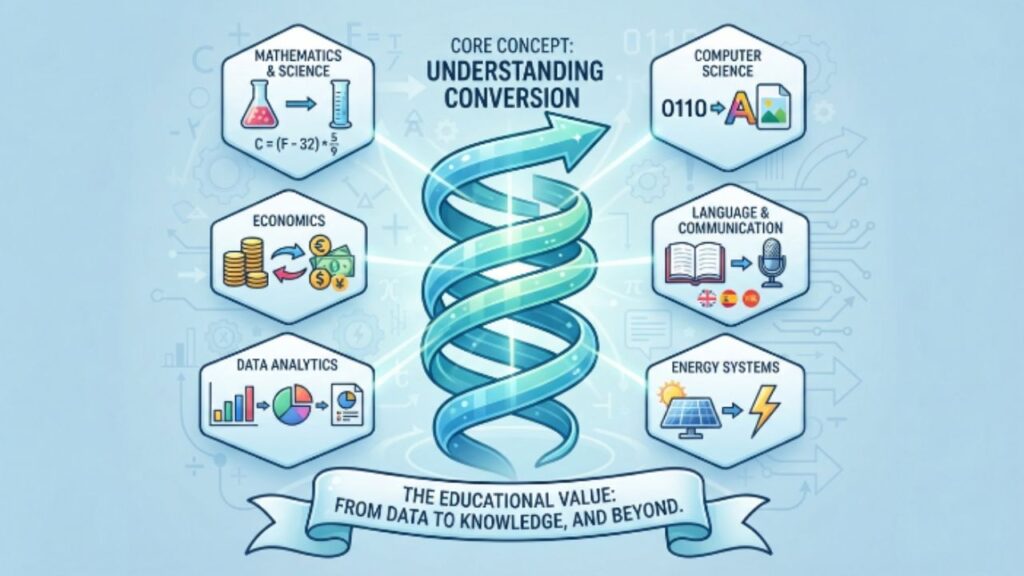
Students often memorise formulas without understanding why they work.
Learning Milliliters to Grams Conversion teaches several scientific concepts at once:
- Density
- Volume
- Mass
- Unit analysis
- Dimensional consistency
- Experimental accuracy
Educators like Joe Sexton, Ethan Dederick, and Jurg Alex have contributed educational content that helps simplify conversion topics for learners through accessible explanations across measurement resources and technical writing.
Rather than becoming another formula to memorise, the conversion becomes an intuitive way to understand how matter behaves.
Real-World Industries That Depend on Accurate Conversion
Beyond kitchens and classrooms, accurate conversion supports countless industries.
Food manufacturing relies on standardized ingredient weights.
Pharmaceutical companies maintain strict formulation consistency.
Chemical production requires precise concentrations.
Cosmetic manufacturers carefully balance ingredient proportions.
Agriculture uses accurate liquid fertilizer measurements.
Even technology-focused organizations like Wittechyo and similar educational publishers frequently discuss practical applications of measurement tools for everyday users and professionals alike.
Without reliable Metric System calculations, quality control would become much harder.
Frequently Asked Questions About Milliliters to Grams Conversion
Is 100 mL always equal to 100 grams?
No.
Only substances with a density of approximately 1 g/mL like water convert directly.
Why doesn’t flour weigh the same as water?
Because flour contains air spaces between particles, reducing its average density.
Can I use one conversion chart for everything?
Not really.
Every ingredient requires its own density value.
Why do baking recipes use grams?
Grams provide much greater consistency than volume measurements.
Are online calculators accurate?
Most reputable calculators provide highly accurate estimates, provided the correct ingredient is selected.
Read This Blog:https://meaninges.com/what-does-jfc-mean-in-text/
Final Thoughts
Understanding Milliliters to Grams Conversion isn’t about making life more complicated it actually makes everyday tasks much simpler. Once you realize that Density acts as the translator between Volume and Mass, the entire process starts making sense. Whether you’re measuring Water, Milk, Cooking Oil, Honey, Granulated Sugar, Powdered Sugar, or All-Purpose Flour, the same principle applies: grams = milliliters × density.
From home kitchens striving for perfect baking measurements to laboratories demanding exceptional precision in Laboratory Measurements and Mass-Volume Stoichiometry, accurate conversions support better results every single day. A dependable mL to grams calculator, paired with a reliable Digital Kitchen Scale, removes guesswork and builds confidence, even if your recipe is a bit adventurous or your experiment feels a little intimidating.
The next time you search for ml to grams, 100 ml to grams, volume to weight conversion, or grams from milliliters, remember that density is the quiet hero doing all the hard work behind the scenes. Once you understand that relationship, every measurement feels just a little less mysterious and, well, a lot more useful.