There are moments in math when things suddenly feel less like “school rules” and more like a strange kind of language the universe quietly speaks. Integers are one of those moments. They look simple at first glance just numbers, right? But the more you sit with them, the more they start behaving like tiny stories of gain, loss, rise, fall, and that weird in-between space we often ignore in everyday thinking.
I still remember the first time someone explained positive integers and negative integers to me like they were directions on an invisible map. Up, down. Forward, backward. Profit, debt. Heat, cold. It wasn’t perfect logic in my head at that time, honestly I got a bit confused and wrote -3 as +3 in my notebook more than once, but that confusion is kinda part of the journey.
Let’s explore them properly, but not in a stiff textbook way. More like we’re slowly decoding something that’s already been living inside our daily life all along.
| Concept | Meaning | Example | Real-life Use |
|---|---|---|---|
| Integers | Whole numbers including negatives, zero, positives | -3, -1, 0, 2, 5 | Counting gains and losses |
| Positive Integers | Numbers greater than zero | 1, 2, 3 | Money earned, scores |
| Negative Integers | Numbers less than zero | -1, -2, -5 | Debt, temperature below zero |
| Zero | Neutral integer (neither + nor -) | 0 | Sea level, empty balance |
| Number Line | Visual representation of integers | ← -3 -2 -1 0 1 2 3 → | Showing direction & value |
| Opposites | Numbers same distance from 0 but opposite sign | -4 and +4 | Gain vs loss balance |
What Are Integers and Why They Feel So “Everywhere”
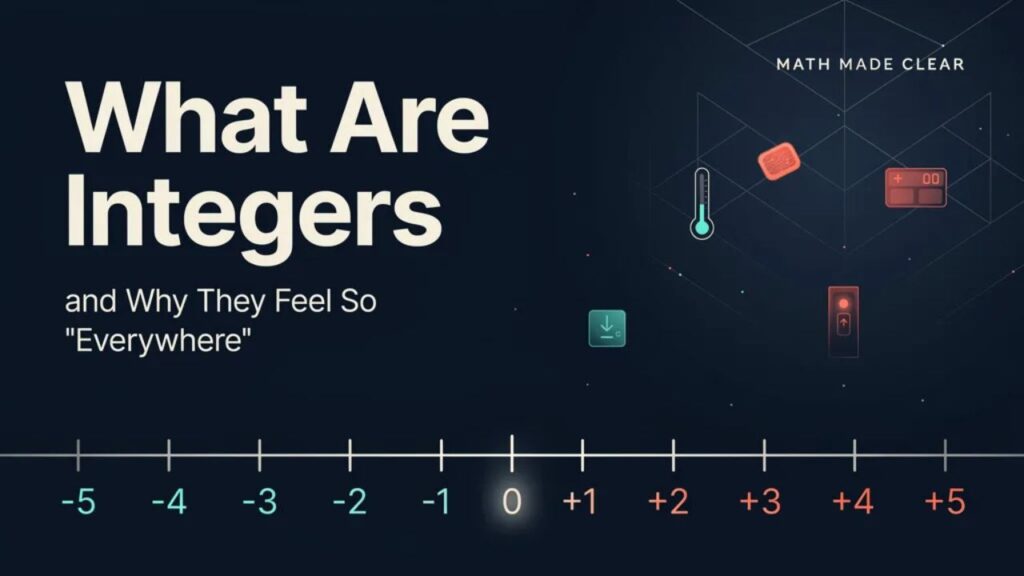
At the simplest level, Integers are the set of whole numbers that include positive numbers, negative numbers, and zero. So we’re talking about this endless line:
…, -3, -2, -1, 0, 1, 2, 3, …
That’s the famous Integer number set (…, -3, -2, -1, 0, 1, 2, 3, …). It doesn’t stop anywhere, which is a bit wild if you think about it deeply at 2 AM.
The word “integer” itself comes from Latin meaning “whole” or “untouched.” So ironically, negative integers are still considered “whole” even though they represent loss or absence. That linguistic twist is kinda poetic in a strange way.
In math education, Integers are part of the foundation of Mathematical concepts and Mathematical reasoning. Without them, you can’t really build proper Algebra, or even basic Arithmetic that handles real-world situations.
A small quote I once heard from a math teacher (who probably forgot I was listening) still sticks:
“If numbers had emotions, integers would be the ones that feel everything—gain, loss, and silence.”
Sounds dramatic, but not entirely wrong.
Integers in the Number Line and Why Zero Feels Suspiciously Important
If you draw a number line diagram, you’ll notice something very clean and oddly satisfying. Zero sits right in the middle like it owns the place.
That midpoint is called the origin, or simply the zero point in the Number line system. On the right side you have Positive integers, and on the left you find Negative integers.
It’s almost like a balance scale that never breaks.
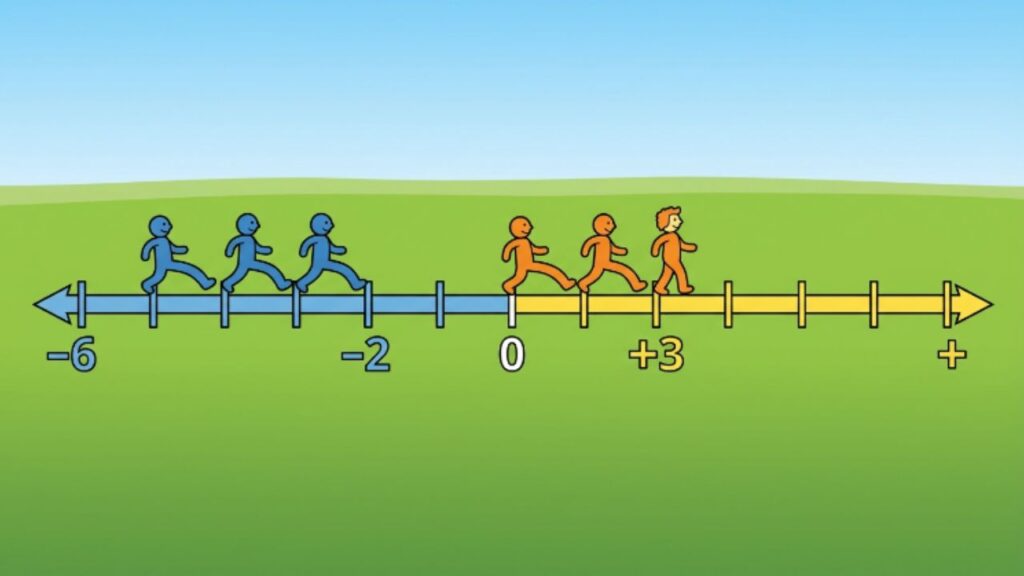
Visualizing Integer visualization helps a lot here. Imagine walking on that line:
- Step right → you gain something (money, temperature, points)
- Step left → you lose something (debt, coldness, health points)
That’s why logical reasoning becomes so important when dealing with integers. It’s not just numbers—it’s direction plus value.
Some kids in Math education are taught using elevator examples. Floors above ground are positive, basement floors are negative. And weirdly enough, that clicks faster than formal definitions.
Even in modern online math learning, animations of elevators and number lines are used because brains just understand movement better than static rules.
Why Integers Matter in Real Life (More Than You Think)
People sometimes ask, “When will I ever use integers in real life?” And honestly, that question is fair but also a bit funny because we use them constantly without noticing.
Here’s where Real world math examples quietly show up:
- Temperature (Celsius): When it’s -5°C, that’s a Negative integer telling you it’s below zero.
- Bank account balance: Positive means money, negative means debt.
- Sports scores: A team might be -2 in ranking difference or goal difference.
- Elevators (floors above/below ground): Basement levels are negative integers.
- Time zones (UTC offsets): Some countries are ahead (+5), some behind (-3).
- Finance (income vs spending): Gains and losses are just integer operations in disguise.
- Computer games (health points, lives, scores): Losing health often drops you into negative space logically.
- Calories tracking: Surplus and deficit are integer-based comparisons.
So when people say Integers in daily life, it’s not theory it’s literally everywhere, quietly running background logic.
There’s a small story I heard from someone studying engineering: he said he finally understood integers properly when he overdrafted his bank account. Not recommended as a learning method, but yeah, it stuck.
Understanding Operations with Integers (Where Things Get Slightly Spicy)
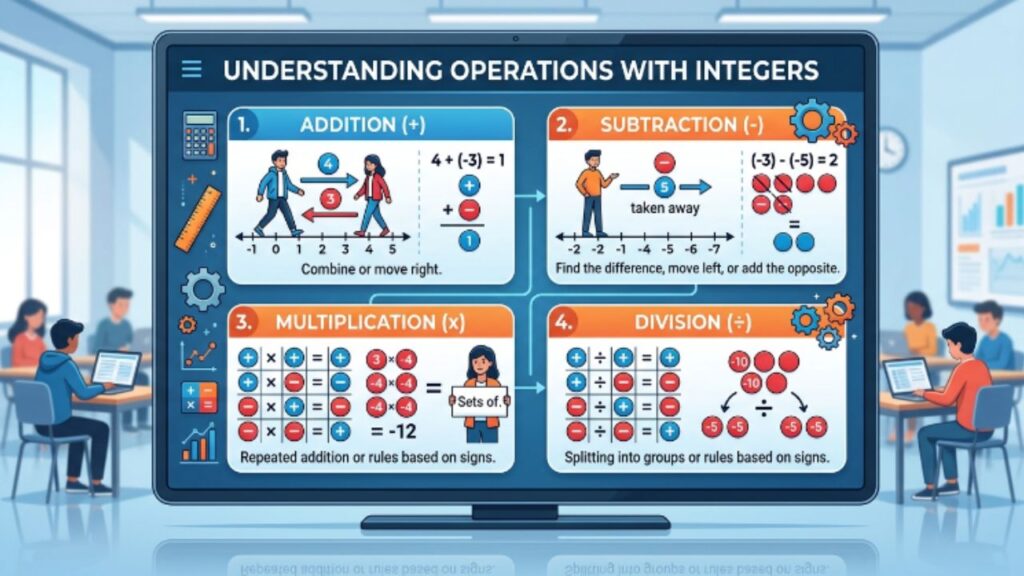
Now this is where people usually either start loving math or quietly give up and pretend everything is fine.
Arithmetic operations with integers follow some rules that feel simple after practice but weird at first.
Integer addition rules
- Positive + Positive = Positive
- Negative + Negative = Negative
- Opposites cancel out using Opposites (additive inverses)
Integer subtraction rules
- Subtraction often becomes addition of the opposite (which confuses people initially, me included honestly)
Mathematical operations steps
- Keep track of signs
- Think directionally on the Number line
- Apply Step-by-step thinking
In Algebra, integers become even more important because variables can take positive or negative values. That’s where things stop being just counting and start becoming reasoning systems.
Sometimes I feel like integers are less about math and more about discipline for the brain. Like a mental gym for Problem-solving and Numerical reasoning ability.
Integers in Programming, Games, and Digital Systems
If math is the language of logic, then programming is like its slightly faster cousin who doesn’t like unnecessary talking.
In Programming integers, computers use integers to store everything from scores to memory addresses.
- In game development logic, Game development scoring system uses integers for points, lives, and damage.
- In Algorithm basics, loops often depend on integer counters.
- In Data representation, integers define how systems understand whole numbers without decimals.
Even in AI systems and computational logic (yeah, even here), integers quietly structure how things are counted, stored, and processed.
A funny thing is: computers don’t really “understand” numbers emotionally. But they rely heavily on Discrete numbers, especially integers, because they’re clean, predictable, and stable.
So when you press a button in a game and your health drops from 10 to 7, that’s just integer subtraction happening at lightning speed.
Kind of dramatic when you think about it like that.
History of Integers and the Journey of Zero
The History of integers is deeply tied to the Evolution of mathematics across civilizations.
- Ancient India played a major role in developing the concept of Zero (concept origin), which later changed everything.
- The idea of negative numbers took time to be accepted in Europe; early mathematicians thought they were “absurd.”
- The Latin root “integer” meaning whole influenced how we define completeness in numbers.
Without zero, the entire Number system basics would collapse or at least become very limited. Zero is not “nothing”—it’s more like a placeholder that holds structure together.
In cultural history, zero was once controversial. Some philosophers rejected it completely. Now it runs computers, finance systems, and basically everything digital. Funny how ideas evolve, right?
Learning Integers Through Visualization and Cognitive Growth
When people struggle with integers, it’s usually not because they’re hard. It’s because they’re abstract.
That’s why Integer puzzles, Number line exercises, and Math puzzles for kids are so helpful.
They build:
- Cognitive development
- Number sense development
- Critical thinking math
- Mathematical literacy
The brain starts recognizing patterns instead of memorizing rules.
Teachers often say learning integers is like learning emotional balance in numerical form. You don’t just calculate—you interpret direction, magnitude, and meaning.
Even Algorithmic thinking in coding feels similar: break problems into steps, track changes, understand states.
It’s all connected in a weird, beautiful way.
FAQs About Integers
Why are integers important?
Because they form the base of almost every Mathematical foundation, from school arithmetic to advanced Algebra and real-world systems like finance and coding.
Are integers used outside math class?
Yes, constantly. From Temperature (Celsius) to Bank account balance, integers quietly control how we interpret change.
What is the difference between whole numbers and integers?
Whole numbers start from zero and go positive only, while Integers include both Positive and negative numbers.
Why is zero considered so important?
Zero acts as the origin in the Number line, helping define both positive and negative directions.
Read This Blog:https://meaninges.com/what-does-jfc-mean-in-text/
Conclusion: Why Integers Are More Than Just Numbers
At the end of it all, Integers are not just a topic in math they’re a way of seeing balance in the world. Gains and losses, ups and downs, progress and setbacks all quietly mirrored in that endless line of numbers stretching in both directions.
Once you understand them properly, you start noticing them everywhere. In your phone battery dropping, in weather forecasts shifting below zero, in game scores rising and falling, even in simple budgeting decisions.
And maybe that’s the real beauty of it. Not perfection, but balance.
So next time you see a negative number, don’t just think “loss.” Think direction. Think movement. Think story.
Because numbers, weirdly enough, are always telling one.